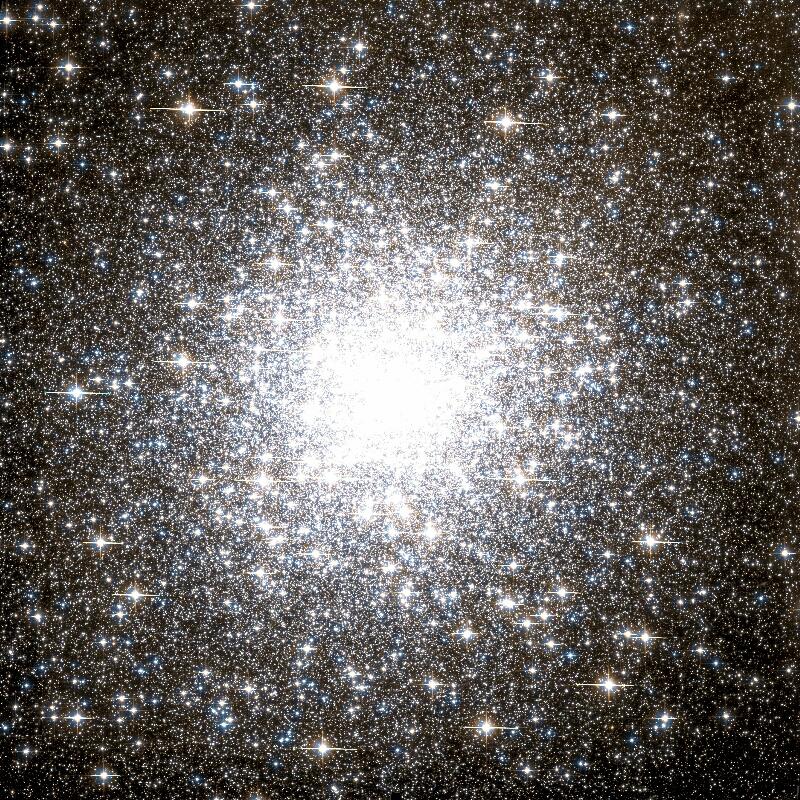
Type: Globular Cluster Also known as: NGC 5272
The next item on Messier's vast list is another globular cluster but, despite looking somewhat less 'intense' than the previous example, is actually slightly closer to us at 30,000 light years, slightly larger than M2 at 200 light years across, and consists of substantially more stars - some 500,000, no less. Some of them are red giants (the yellowish ones here) but most are hotter blue giants, many of them variable.
There are actually, at present count, 274 variable stars in M3 which is considerably more than in any other globular cluster, and it's thanks partly to these that it has become one of the best-studied such clusters in our skies. It's not as old as M2 at a mere 8 billion years old (compared to 13) but it's probably a more interesting target for amateur astronomers with decent enough equipment.
Observation: Many consider M3 one of the best clusters in the northern skies for observations. While barely visible with the naked eye, even in superb conditions, it can be spotted with binoculars and observed quite well with an average telescope. It's located in the Canes Venatici constellation and can be found almost exactly halfway between Arcturus and Cor Caroli. While an impressive sight by itself, those with a good telescope may even spot some background galaxies as well.
Showing posts with label Star Clusters. Show all posts
Thursday, 29 October 2015
Wednesday, 14 October 2015
M2 - Globular Cluster
Type: Globular Cluster Also known as: NGC 7089
When most people think of astronomical objects, it's usually the varied shapes and colours of nebulae that they remember, but star clusters can be just as beautiful. Take this one, for example - the second object on Messier's list - which is a globular cluster. In fact, it's actually one of the largest such clusters currently known, and it's also one of the oldest detected at around 13 billion years old.
Its large size is down to the sheer number of stars it contains - somewhere in the region of 150,000, which makes it 175 light years in diameter - but it is also very distant at 37,500 light years. As such, it was originally thought to be a nebula when discovered in 1746 by Maraldi, then again in 1760 by Messier himself who thought it was a 'nebula without stars' as it is so densely packed.
Observation: M2 lies well beyond the Galactic Center within the constellation of Aquarius. Despite being so far away, it's just about bright enough to be made out with the naked eye in excellent conditions, though it will appear only as a point of dim light. A large telescope is required to make out any individual stars, however.
When most people think of astronomical objects, it's usually the varied shapes and colours of nebulae that they remember, but star clusters can be just as beautiful. Take this one, for example - the second object on Messier's list - which is a globular cluster. In fact, it's actually one of the largest such clusters currently known, and it's also one of the oldest detected at around 13 billion years old.
Its large size is down to the sheer number of stars it contains - somewhere in the region of 150,000, which makes it 175 light years in diameter - but it is also very distant at 37,500 light years. As such, it was originally thought to be a nebula when discovered in 1746 by Maraldi, then again in 1760 by Messier himself who thought it was a 'nebula without stars' as it is so densely packed.
Observation: M2 lies well beyond the Galactic Center within the constellation of Aquarius. Despite being so far away, it's just about bright enough to be made out with the naked eye in excellent conditions, though it will appear only as a point of dim light. A large telescope is required to make out any individual stars, however.
Subscribe to:
Posts (Atom)